Earn Your Boots Back: A Six-Week Rebuild for Returning Sunday Footballers
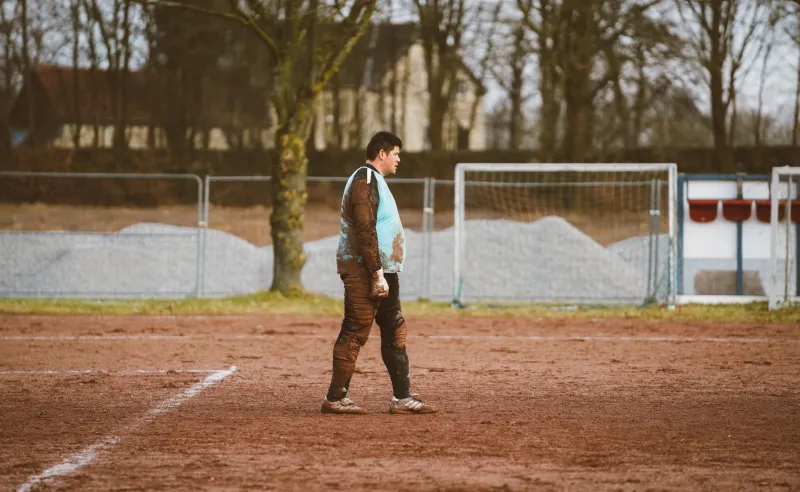
The first Sunday back after a long layoff usually follows the same script. You dig out the boots, tell yourself you'll take it easy, then spend 20 minutes chasing a winger who plays five-a-side twice a week. By Tuesday your hamstrings have filed a formal complaint and your calves are sending passive-aggressive emails.
The problem is rarely desire. It's dosage. A Sunday league match is not a gentle fitness test. It's repeated accelerations, decelerations, awkward turns on a heavy pitch, and unpredictable sprinting, often after a week of sitting at a desk. If you have spent months away from that, the sensible move is not to prove how much you've missed it in one 90-minute burst. It's to rebuild your tolerance in stages.
This is a six-week bridge from sofa to Sunday league. It is not a pre-season for a professional. It is a practical reconditioning block for people with jobs, families, and a council pitch that turns into a bog every November.
The comeback is a loading problem
Return-to-play guidance generally favours criteria-based progression over a rigid calendar: you move on when you can tolerate the next demand, not simply because a date has arrived. But most amateur footballers do not have a physio on the touchline, so a calendar gives you a useful frame. The trick is to treat each week as a question: can you handle this load and recover within 24 hours?
Hamstring injuries are one of the most common problems in amateur football, and the evidence consistently points towards eccentric hamstring strength and gradual exposure to high-speed running as key tools. Your calves matter too. They absorb huge forces when you sprint and change direction, and they often get ignored until they seize up in the 70th minute. Add single-leg strength, trunk control, and a sane approach to cutting, and you have the foundations of a comeback that doesn't collapse in week two.
The non-negotiables
Two strength sessions per week. Keep them to 35 to 45 minutes. You do not need a performance centre. A garage, a council gym, or a spare 40 minutes at lunch will do.
One running or football-specific exposure per week. This is separate from the strength work. It starts easy and becomes more specific over the six weeks.
Use the 24-hour rule. If pain, swelling, or stiffness is worse the next day, you did too much. Back off the next session rather than pushing through.
Do not stack high-impact days. If you play five-a-side on Tuesday, do not schedule sprint work on Wednesday. Your tissues need time to adapt.
Keep the easy days genuinely easy. The comeback is not the time to turn every walk-jog into a race against a Strava segment.
The six-week template
| Week | Twice-weekly strength focus | Football-specific exposure | Example week |
|---|---|---|---|
| 1 | Split squat, Romanian deadlift, calf raise, plank. Controlled reps, 2 to 3 sets. | 20 to 25 minutes walk-jog: 3 minutes brisk, 2 minutes easy. No sprinting. | Mon strength, Wed walk-jog, Sat strength. |
| 2 | Add Nordic curl negatives and lateral step-downs. Keep weights modest. | Same walk-jog plus 4 x 20-second strides at about 70 per cent effort. | Mon strength, Thu run and strides, Sun strength. |
| 3 | Increase strength sets slightly. Add single-leg calf raises. | 5 x 10-metre accelerations from a standing start. Walk back. Full recovery. | Tue strength, Thu accelerations, Sat strength. |
| 4 | Add a short-lever Copenhagen plank and deceleration drills. | 20 to 30 minutes controlled small-sided play, or 4 x 5-metre decelerations. | Mon strength, Wed football, Sat strength. |
| 5 | Maintain strength, reduce volume if legs feel heavy. | 40 to 45 minutes controlled small-sided play with planned changes of direction. | Tue strength, Thu football, Sun strength. |
| 6 | One full strength session plus one short top-up. Prioritise freshness. | 60 to 75 minutes match simulation. If symptom-free, target 90 minutes the following week. | Mon strength, Wed match simulation, Sat top-up. |
The final week is not about proving you can survive 90 minutes in training. It is about arriving at your first match with enough exposure that the demands are familiar. If you can complete week six without next-day flare-ups, you are in a reasonable place to play. If you cannot, repeat a week. The calendar is a guide, not a judge.
The strength menu that earns its keep
You do not need a complicated programme. Pick two or three lower-body lifts, one calf movement, and one trunk exercise per session. Keep the effort around 6 to 7 out of 10. You should finish each set feeling like you had two or three reps in reserve.
Good options include split squats, Romanian deadlifts, step-downs, Nordic curl negatives, seated or standing calf raises, Copenhagen planks, and side planks. For the Nordics, start with three sets of three to five slow negatives. Do not chase full reps if your hamstrings are not ready. For calf raises, aim for three sets of eight to twelve reps, and include a straight-leg and bent-knee variation across the week.
The goal is not to get sore. The goal is to build tissue tolerance while you gradually add running and cutting. Soreness that lingers into the next day is a sign you overshot.
Sprinting and cutting: earn the right
The biggest mistake in a comeback is going from zero to full-pace sprinting in a match. Sprinting is a skill and a load. Your hamstrings and calves need to be introduced to it before you ask for repeated maximal efforts on a muddy pitch.
Start with strides: short, controlled accelerations at 70 to 80 per cent effort, with a walk-back recovery. Then add short accelerations from a standing start. Only after that should you introduce decelerations and changes of direction. When you do, keep the volume low and the quality high. Four or five good efforts are better than 20 sloppy ones.
On the pitch, warm up properly. Include some skips, leg swings, and a few progressive runs before you touch the ball at pace. If you are on the bench, use the first five minutes to get moving rather than sitting still and then sprinting cold.
Red flags: when to see a physio
Most comeback aches are manageable. Some are not. Seek an assessment from a physio or GP if you notice sharp pain in the hamstring, groin, or calf; swelling that does not settle; a sudden pop or giving-way sensation; locking or catching in the knee; pain that wakes you at night; numbness or pins and needles; or pain that is clearly worse 24 hours after activity. Groin pain that worsens with coughing or sneezing also deserves a proper look.
If you have had surgery, a fracture, or more than 12 months away from impact activity, get individual advice before starting this template. The plan is a general reconditioning guide, not a personal diagnosis.
The first match back
Start on the bench if you can. Aim for 20 to 30 minutes, then build. Pick your moments. Do not launch into a full sprint in the first five minutes just because the ball is there. Keep your warm-up honest, drink something before you feel desperate, and treat the day after as part of the session: easy walking, food, sleep, and no heroic gym session.
The Sunday league comeback is not a test of character. It's a project in load management. Build the strength, earn the sprinting, respect the red flags, and you give yourself a much better chance of being useful in November, December, and beyond.