The Finished Stroke: A Four-Week Rowing Block for Lifters Who Hate Cardio
Most lifters treat the rowing machine like a parking ticket: an annoying thing you deal with before the real business of lifting. Five minutes before squats, maybe a grim little finisher if guilt gets involved. That is a waste. A rower is not just cardio in a corner. Used properly, it is a strength-endurance tool that trains the trunk, hips and upper back through a long stroke, with almost none of the soreness that comes from running.
This is a four-week block for people who lift and dodge cardio. Three weekly erg sessions, clear pacing, and enough restraint to keep your barbell numbers moving. No weekly 2k time trial. No heroics.
Why the rower suits people who live under a bar
Rowing is low impact and mostly concentric. You are not loading the eccentric part of a squat or a run, so it does not leave your legs wrecked for the next session. It also asks your trunk to hold position while your legs and arms do very different jobs. That is useful for lifters: it teaches bracing under fatigue without another set of heavy hinges.
For UK gym-goers squeezing training around work, family and the weather, the rower is also reliable. It is already in most leisure centres and commercial gyms. You can dose it precisely in minutes and metres, which makes it easier to fit around a strength plan than a vague session on the treadmill.
Set the machine before you set the pace
Most gyms have a Concept2 or a close copy. Start with the damper, not the monitor. The damper is not a resistance dial. It changes how much air the flywheel catches. For most lifters, a damper setting of 4 to 6 is plenty. If you want a number, aim for a drag factor of roughly 110 to 130. A higher number is not more manly; it just makes each stroke heavier and can turn the session into a lower-back grind.
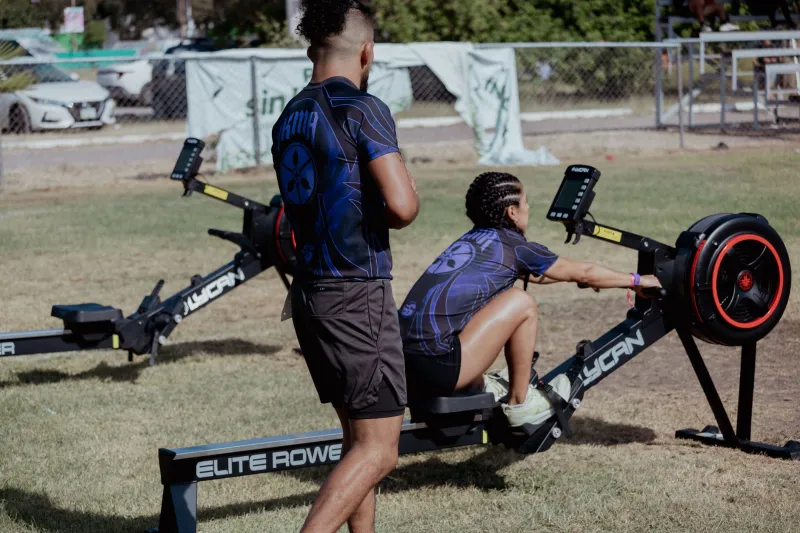
Set the feet so the strap crosses the ball of the foot, not the toes. At the catch, shins near vertical and shoulders relaxed. Drive with the legs first, then swing the body, then pull the arms. On the way back, reverse it: arms, body, legs. Keep the handle finishing around the lower sternum, not at your chin. If the monitor split is falling but your lower back is doing the work, you have missed the point.
Use split, not vibes. The split is your pace per 500m. If you do not know your numbers, warm up for five minutes easy, then row three minutes at a hard but controlled effort, roughly 7 out of 10. Note the average split. That is your anchor for the block. It is not a 2k test and it does not need to be perfect.
Three sessions that earn their place
Do one easy, one moderate and one harder session each week. The harder one should still feel controlled. Rate caps matter: if you are thrashing at rate 32 when the plan says 24, you are just practising poor positions at speed.
Session A: Power intervals. Six rounds of 250m with 90 seconds easy rowing between. Pace them at your anchor split or two to three seconds faster. Rate 24 to 28. These are short, sharp and technical. Stop the set if the stroke turns into a tug-of-war.
Session B: Steady row. Twenty to twenty-five minutes continuous at anchor plus 12 to 15 seconds slower. Rate 20 to 22. You should be able to speak in short sentences. This is not a punishment; it is trunk and aerobic work that should leave you fresher than a hard run.
Session C: Tempo blocks. Three rounds of six minutes at anchor plus six to eight seconds, with two minutes easy between. Rate 22 to 24. If you are new to rowing, start with two blocks and build. Keep the splits even. A fast first block and a dying third block is not a tempo session; it is a lesson in pacing.
Pairing it with barbell work
Put the rower after strength work, not before heavy squats or deadlifts. You want your best positions and your best focus for the bar. A hard erg session and a heavy lower-body day should not share the same 24 hours if you can avoid it. If your week is tight, use the easy steady row after lifting and put the power intervals after an upper-body day or on a non-lifting day.
Cap hard rowing at two sessions per week. The third session is deliberately easy. That is not laziness; it is how you keep the block from eating your recovery. Fuel around the session like you would for training: a normal meal with carbs beforehand, protein and carbs afterwards. Do not chase a personal best every week. The progression is the point.
The four-week progression
| Week | Power session | Steady session | Tempo session | Rule |
|---|---|---|---|---|
| 1 | 6 x 250m | 20 min | 2 x 6 min | Leave two reps in the tank |
| 2 | 8 x 250m | 22 min | 3 x 6 min | Same pace, a little more work |
| 3 | 5 x 500m | 25 min | 2 x 8 min | Biggest week; do not also smash the pace |
| 4 | 4 x 250m | 15 to 18 min easy | 1 x 8 min | Reduce volume, keep one sharp touch |
In week 3, the 500m repeats should be at anchor plus four to five seconds, not all-out. If your form breaks, row easier. In week 4, the block backs off on purpose so you can return to normal barbell training without carrying fatigue.
What progress actually looks like
You do not need a heroic 2k score to call this a win. Good signs are simple: the same split at a lower stroke rate, a more stable finish, less lower-back ache after steady rows, and a tempo session where the last block matches the first. If your split is drifting badly or your back is complaining, check the damper, shorten the session and slow down.
The rower is not a punishment. It is a boring, useful machine that rewards good positions and patience. Four weeks is enough to find out whether you have been avoiding a genuinely useful training tool, or just avoiding the bit where you have to pace yourself.